Friday, March 23, 2012

Potatoes


Monday March 19 I planted potatoes in North Central Wisconsin. The temperatures have been setting record highs for several days and no freezing weather is in the forecast. If the weather stays warm I will harvest the first new potatoes in early June. March 17 is the earliest I ever planted potatoes when I lived in Ohio. The chance of these potatoes being nipped by frost is high but if the potatoes get nipped with frost they will recover but the yield may be less. I may have to cover the plants. Our frost free day is May 22.

My mother read an article advertizing a potato planting system using their particular tubs filled with potting soil. As the potatoes produced tubers, you could reach into the soft soil, possibly straw on top, and harvest what you need. Two years ago a friend from West Virginia bought some potatoes sold for seed to plant in pots. Later that year she said one plant had produced 28 edible potatoes and she was still harvesting. She couldn’t believe the productive potential of one small potato seed piece.

Another friend asked about growing potatoes in straw. Check out these web sites.
http://www.colostate.edu/Depts/CoopExt/4DMG/VegFruit/potatoes.htm
http://www.vegetable-gardening-online.com/growing-potatoes-in-straw.html

Growing potatoes in straw will work. Remember that the seed potato piece needs to be on the soil so the roots penetrate the soil to get nutrients and water. Two years ago all of the potatoes I harvested were not used. A few were stored in a box in the basement where temperatures remains somewhat cool and it is dark. At potato harvest time in late September I retrieved the box with the potatoes. The potatoes had grown vines and growing off the vines were a few small potatoes. One of the potatoes was the size of ping pong ball. The variety was Yukon Gold and the daughter potato had perfectly smooth skin. All the vine and little potatoes formed from carbohydrates, nutrients and moisture in the parent tuber.

Remember to choose good certified seed potatoes. From experience with side by side rows, potatoes from good seed grew much better, produced much higher quality, and yielded much more than the row planted from low quality seed saved from the year before.

Here are potatoes I am familiar with and can recommend:
Reds – Norland, Pontiac (Norland has smoother skin and shallower eyes)
Whites – Kennebec, Katahdin, Shepody, Snowden
Russets – Burbank, Norkotah, they are mostly all good.
Yellow flesh - Yukon Gold, Yukon Gem
Specialty potatoes - Many fingerlings and specialty colored potatoes

For a list and description go to this web site:
http://potatoes.wsu.edu/varieties/vars-all.htm
Thanks Washington State University

The seed potatoes you mostly end up with will be what the garden center or store you get the seed from offers. You can plant potatoes from the grocery store but they may have been treated with a sprout inhibitor that will delay and slow growth.

A last thought; the best mashed potatoes I have ever eaten were from a combination of Russet, Yukon Gold, and Red Norland potatoes. The flavor was well rounded and complete with a varietal mixture.

The Garden Doc

Friday, March 16, 2012

Maple Syrup

Making maple syrup has always been a dream ever since learning about it in grade school.  While visiting a hardware store I found a little book about making maple syrup with the taps used to extract the sap from maple trees.  The book and a few taps are now mine.  I hope I have sugar maples!

Last Saturday seemed like the perfect day to start.  Following the instructions in the book, I got my portable drill, attached a ½ inch bit and scooted out to my maple trees.  The book said use a 7/16 inch drill, but I only had a ½ inch drill.  I doubt the tree knows the difference.  Following the directions, I drilled a hole slightly upwards into the trunk.  The tap was inserted with ease and a little tap-tap with a rubber mallet secured it.  The tap comes with a little hook to hang the bucket but being in the modern era, I attached a clear plastic hose and ran the sap into a clean 5 gallon bucket. 
The inserted tap.  If you look carefully you can see a drop of sap.
As soon as the drilling and tapping was complete little drips of clear liquid started seeping out of the taps.
The modern hose and bucket system.  Would you believe there was snow when the tree was tapped.
The best maple syrup weather is warm sunny days and cold nights.  Saturday was a warm sunny day and as the next few days rolled along the days got warmer and the nights never really got cold.  Most of the temperatures this week have been in the high 60’s to 70’s.   Despite the lack of ideal weather, one week later I had about two gallons of sap.  Most of it was obtained on Saturday and Sunday, day one and two.

One week later is boil down day.  It takes 40 gallons of sap to make 1 gallon of maple syrup.   My 2 gallons of sap should make a little less than a cup of pure maple syrup.  The straight sap has no taste.  After losing 50% of the water it starts to have a slightly sweet taste.  After 75% evaporation it tasted like a sweetened drink.  At 1 cup, maple syrup was the result.
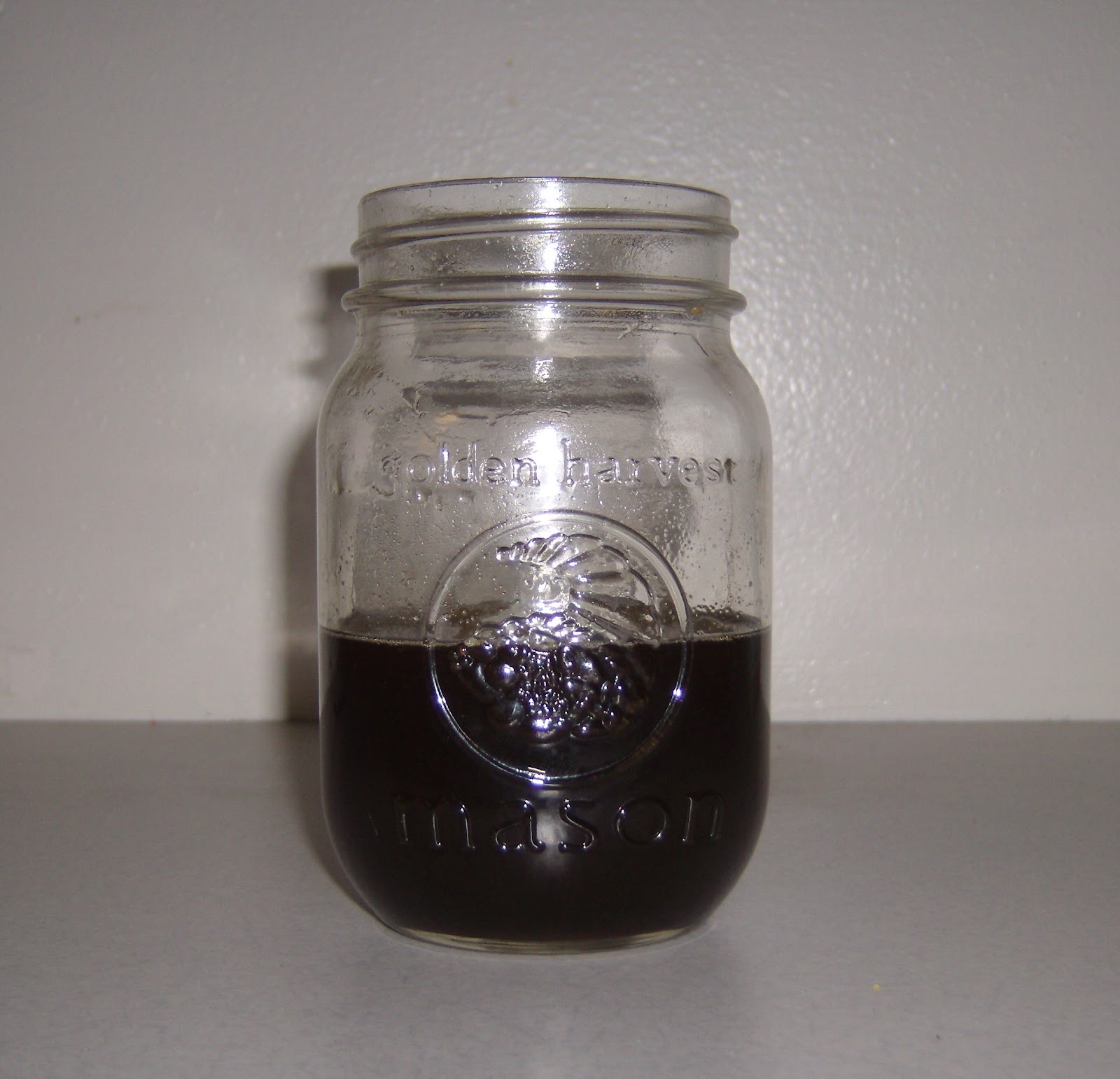
My scant 1 cup of maple syrup still warm in the jar
The March 1 post, with pictures, describes a visit to an actual maple syrup shed with a large evaporator.

Maple syrup houses always use wood fires for evaporation, because it is inexpensive, and stainless steel evaporation pans.  My hobby operation, or experiment, used the kitchen stove and a stainless steel pan.  I could have jerry-rigged something else but the stove was sitting there calling for its use and made it simple.   The cost of electricity for evaporation was probably sky high but who is counting for one cup of pure home made maple syrup.

Should be pancakes tomorrow.

The Garden Doc

Wednesday, March 14, 2012

To Mulch or not to Mulch

A major lawn herbicide was taken off the market eight to ten years ago because compost made with lawn clippings caused damage to plants the compost was applied around.  A specific herbicide sprayed on the lawns survived the heat and microbial process of composting.  A subsequent study found lawn clippings used as mulch after common lawn herbicides were applied damaged several vegetables.  Clippings from treated lawns caused damage for a few weeks after the herbicide application.  The bottom line is, “use caution” if you make pesticide applications to lawns then use the grass clippings for garden mulch.   

When planting beds, whether flower or vegetable, consider mulch for both aesthetics and weed control.  Below is a short discussion of different mulch or weed barriers.

Landscape fabrics – These are great for long term use in perennial plant beds or as removable weed mats in vegetable and ornamental gardens.  They are quite costly but last for years.  If in permanent landscape, bury under rocks or wood mulch and cut holes where plants will be planted.  Water and nutrients will filter through the mat but weeds won’t grow through the mat.  A few weeds may grow through the transplant hole and eventually enough dirt and weeds seeds will be present to grow a few weeds on top of the mat.  They are usually black on not very pretty.
Red plastic mulch

Plastic mulch – Plastic mulch works well in seasonal gardens, especially in vegetables.  They mainly keep weeds out but also can keep soils moist, and heat the soil for quicker growth in cold climates.  Water doesn’t penetrate plastic mulch so it must soak in from underneath the edges or have a water line under the plastic.  Clear, black, or colored plastic all work.  Weeds will grow under clear plastic but not colored or black plastic.  The aesthetic value is very low if using in ornamental beds.  Plastic is inexpensive.
Properly transplanting and mulching of a tree

Wood, Straw, Pine bark nuggets, Pine straw (needles) – These work similarly with the only variable being the texture and color.  Basically any vegetative material would work if it didn’t overload the soil with excess nutrients.  Most mulch is applied more for the aesthetics and then provides the weeds control.  In times past it was applied for weed control then when the mulches were visually appealing in the landscape the purpose shifted.  The problem with most mulch is it gets applied way to thick.  The worst is when it is mounded around tree trunks.  Many over mulched trees will eventually die. Organic mulch should be one to 2 inches thick and not cover the root flare on trees or lower the soil line on perennials and annuals.  These mulches have been shown to provide 80+ percent weed control when an inch thick.  A product of herbicide impregnated mulch now is on the consumer market for homeowner use.  It works and definitely should not be over applied. Tender transplants may not grow in around herbicide treated mulch. 
Grass clipping do work as mulch.  They have some nutritive value, but usually during the next year.  They can provide weed control just like any other mulch for weed control.  Some people have used odd materials such as cardboard.  Weeds rarely push through items like cardboard but it isn't very pretty.

Years ago a local scout troop I was associated with got the contract to supply mulch to several local church houses.  The troop was able to sufficiently fund its activities for two years with one day of several folks working hard.  A wood products company about a mile from my house has a major seasonal business of providing colored mulches bulk to homeowners who pick up one small pickup load for $30.  His mulch comes in two or three shades of red to brown, black, blue and who knows.  Blue wasn’t the most popular color but eventually disappeared.

The mulch business is big business.

Avoid volcano mulching trees


Thursday, March 8, 2012

A win for malnourished children & GMO

A celebration of new technology.
Golden rice with Vitamin A vs normal polished white rice
Golden rice was developed to reduce child mortality due to vitamin A deficiency.  The science was developed and produced golden rice from 1980 to 2005.  Anti-GMO (Genetically Modified Organisms) advocates argued that this would cause major problems throughout the world if this technology was used.  This argument never considered the benefit of saving the 2-3 million children who die per year and the 500,000 children per year who become blind due to poor nutrition. 

Big companies are not evil.  Many of the technologies used are patented by various companies or individuals.  Syngenta AG has negotiated for all the necessary technologies to provide the Golden Rice Humanitatrian Board with the right to sublicense rice breeding organizations in developing countries free of charge. 

The new Golden Rice variety will also contain improved genetics and tolerance to some diseases to improve rice quality and quantity during production.  The golden color in the rice grains come from beta carotene.  Rice plants always produced beta carotene in the plant but it was not transferred to the kernal.  The kernals now contain beta carotene including lutein and zeaxanthin.  
Rice plants ready to harvest.
Dr Peter Beyer of Centre for Applied Biosciences, Univeristy of Freiburg, Germany and Professor Ingo Potrykus of the Institute for Plant Sciences, Swiss Federal Institute of Technology constructed the grains missing biosynthetic pathway.  The first success produced 1.6ug of beta carotene in 1 gram of rice.  By 2005 the system was improved to supply 31 ug/g of beta carotene in rice.  This exceeds the dietary requirement of vitamin A in 100 to 200 g of rice.   They and Syngenta deserve a humanitarian award.

Kudos to modern science and the humanitarian efforts of all involved.  Millions of lives will be saved and millions more individuals will start life with improved health.  Check http://www.goldenrice.org/ also google Golden Rice.

Tuesday, March 6, 2012

Starting Plants Indoors

Alaska’s climate is too cold to grow sweet corn the conventional way.  They do not have enough growing degree days to get corn to mature.  Bryan, my brother, and his corn growing mentor have grown sweet corn successfully for many years in Alaska.  How?  He starts sweet corn in a greenhouse about one month before it is time to transplant in the garden.  When temperatures are finally warm enough, he transplants into the garden.  The corn is given a better chance by planting through holes in plastic.  The plastic does warm the soil creating a warmer microclimate for the corn roots.  The last key is growing the shortest maturity varieties of corn available.

Plants best started indoors and easily transplanted are tomatoes, peppers, broccoli, cabbage, most flowers, watermelon and cantaloupe.  Plants best planted directly into the garden are peas, corn, beans, radishes, cucumbers, lettuce, carrots, beets, onions, leeks, and potatoes.  Are the terms seeding and planting interchangeable?  Seeding refers only to putting seeds into the ground.  Planting refers to putting plant parts, including seeds into the ground.

When is the right time to plant both seeds and plants?  Potatoes, peas, red beets, radishes, and onions grow great when seeded as early as the garden can be prepared to plant.  Broccoli, cabbage and other cole crops will survive very well in cold climates whether seeded or transplanted, as long as the indoor grown plants are hardened off before setting outside.  Corn, beans, cucumbers, melons, squash, tomatoes, and peppers should be delayed until all chances of frost are past and the soil is good and warm.  Lettuce, carrots, parsnips, and a few others are somewhat cold tolerant but shouldn’t be planted too early.

When starting seeds indoors make sure you use clean containers.  If you reuse old containers rinse in a mild bleach solution then rinse.  This is to control diseases.  Use a good potting mix.  The best potting mixes may not have the biggest name or cost the most.  Potting mixes with vermiculite, peat moss, and/or coir work very well.  Keep seeded pots moist but not overly wet.  If you have a cold location you may use a heat mat to keep soils in the 70 degree range.  When seeds are germinated and have true leaves, you may remove the heat mat.

The most important part of growing starter plants is to provide enough light to imitate sunlight.  Grow lights generally work.  Incandescent and fluorescent lights together provide a complete light spectrum.  Either alone provide an incomplete light spectrum.  If you have a greenhouse outside, natural light is the best, but due to the plastic intercepting some light rays and frequent cloudy late winter or spring days you should plan on supplementing with artificial light.  Plan to provide light for 14 hours.  Plants do need both light and dark.  Part of the photosynthesis process requires a dark period.  If plants don’t get enough light they get “leggy” which is spindly overly tall plants.  Professional growers often treat with a growth regulator to keep plants short.  Homeowners can’t easily buy these growth regulators and if you can they can be very tricky to use.

The time to plant varies based on where you live.  Still some items can be planted as soon as you can get into the garden, others after the frost free day which is often in May to late May in the northern US.  A good rule of thumb for many northerners is to plant frost sensitive plants on or after Memorial Day.

When in graduate school I transplanted some broccoli plants a couple of days before my second child was born.  That week end was a whirl wind weekend as well as a colder than normal weekend.  If the broccoli plants were hardened off they would have survivied but they froze.  The busy weekend meant I didn’t get them covered or pay attention to the low temperature forecast.

BONUS – Check out these designer pumpkins. 
http://vegetablegrowersnews.com/index.php/multimedia/photos

The Garden Doc

Friday, February 17, 2012

Nematodes and other garden problems

Modern vegetable production uses fumigants to clean the soil from many soil diseases, nematodes, and some weeds.  Fumigants are often quite toxic and often applied as a gas into the soil.  The soil may be covered with plastic to hold the fumigant in the soil to better kill the pathogens.  After a period of time the fumigant either dissipates and/or decomposes.  Then the plant is either seeded or transplanted into the soil, often through holes punched into the plastic.  The results are improved plant growth with less disease and often free of damaging nematodes.
Forked carrots caused by nematodes
Nematodes are minute round worms that live in the soil and often infect plant roots causing slow plant growth, forked carrots and other maladies.  They are so small they are usually not visible to people and there are numerous species.  Some common nematodes are cyst, root knot, lesion, dagger, and sting nematodes.  There are a few foliar nematodes and others cause medical problems in humans and other animals.

So, what can you do?  Most home gardeners do nothing and accept the damage.  There is a solution that will give your garden a great advantage.  Members of the brassica family such as mustard, turnip, and radish plants produce natural chemicals that can control or at least limit the damage from nematodes and plant diseases.  The diseases that may be controlled are verticillium, pythium, fusarium, rhizoctonia aphanomyces, and fusarium. 
Mustard plants in flowers
These plants are cool season annuals that can be planted in the fall as a cover crop or in very early spring.  When the mustard plants are chopped up and tilled into the soil, they decompose.  The decomposition releases glucosinolates which act as a biofumigant.  The plants, especially the mustard should be chopped and tilled before or at flowering time so the seeds don’t mature.  Mustard plants can be a weed that easily gets out of control.  Using these plants as a natural fumigant will not inhibit the growth of vegetables and the food grown will be perfectly safe to eat.
Tillage radishes
Turnips and tillage radishes can be planted in the fall and grow very well before freeze up.  (Don’t use the small round radishes)  The long cylindrical radishes grow quickly and produce a taproot that will grow deep into the soil improving the soil characteristics.  The deep root when decomposed creates channels that help handle soil water.  Turnips will grow similar to tillage radishes but don’t grow as deep.  When the turnips and radishes are tilled they also release chemicals that help control nematodes.  Tillage radishes and turnips can be seeded in the fall and generally will grow enough to be effective in improving next year’s garden.  Do remember to chop well and till into the soil.  If you choose to grow them as a cover crop, they do provide animal food and are grazed.  You, also, can eat them if you desire.

The Garden Doc

Monday, February 6, 2012

The Color of Food


Years ago two east coast chicken companies waged a battle over whether raw chicken, you buy in the store, should be white or yellow in color.  Dr. Baldwin at the Virginia State University Research Station in Painter, VA conducted research on growing marigolds for the purpose of feeding the flowers to chickens and the chickens would be yellow in color.  It works.  A medical mystery book from years ago had a story about a person who went to the doctor because he was turning orange.  He drove a lot and ate carrots while driving.  The solution was to quit eating so many carrots.  The orange color in carrots and marigolds is mostly carotene.  Green vegetables may contain many of the following colors but chlorophyll usually masks all the other colors. 

Nutritionists always say to eat a wide variety of fruits and vegetables.  The chemicals that give fruits and vegetables their bright colors are some of the most potent antioxidants people can obtain as well as many being studied for anti cancer treatment and important for other vital parts of the body such as the eyes.  Search some of the colorants below and be prepared to be amazed at why they are being studied.
 
Red Fruits & Vegetables
Lycopene is a bright red carotene commonly found in tomatoes.  Anthocyanins are red purple or blue.  They are flavinoids in purple corn, berries, and eggplants.

Orange & Yellow Fruits & Vegetables
Beta-carotene is red or orange, and commonly found in carrots.  Also called terpenoids.  Flavinoids, also called bioflavinoids are the yellow color in citrus, tea, wine & chocolate.  Quecertin and hesperidin are flavinoids.
           
Green Fruits & Vegetables – Green covers up most other colors even when they are present.  
Cholorphyll is green and changes light into glucose in plants.  It is not known to be that active in human health.  Lutein is yellow but found in green plants where chlorophyll covers the yellow.  Zeaxanthin is red to orange and is one of the xanthophylls and important for eyes.  Beta-carotene – See above
Blue & Purple Fruits & Vegetables
Lutein – See above
Zeaxanthin – See Above
Resveratrol is bright red or brown and found in grapes and other fruits.  May extend life and prevent cancer.
Flavonoids - See above
Anthocyanins – See above

White Fruits and Vegetables
EGCG or Epigallocatechin gallate is clear to yellow and is a potent antioxidant
Red Beets – Betalains are a different class causing the red in beets but can also be yellow.  In some plants they replace the anthocyanins.  Betacyanins are red to yellow and Betaxanthins are yellow to orange.  Betanin is a potent red color.  All are antioxidants.   

The red color from beets is often used to color other foods.  They are considered healthful and have/are being studied for cancer control and other healthy benefits.  There is a subtle side effect from betacyanin in beetroot which may cause red urine and poop in some people who are unable to metabolize betanin. This is called beeturia.  If you ever come home from a party and pass red urine the red punch may have been colored with beet juice.  (I apologize for a little coarseness but these are facts.)

The Garden Doc