Showing posts with label Green Light. Show all posts

Friday, July 22, 2011

Summer Flowers


A well landscaped yard

Recently I visited my brother.  He had some of his yard professionally landscaped.  The ornamentals in his yard are a succession of blooms all summer long.  There are a few non blooming ornamentals.  During my visit there was a wonderful aroma from the Idaho state flower, the syringa.  The bushes were 5 to 6 feet tall and in full bloom.  I would recommend syringa for anybody who lives in a location that can grow them. 
Poppies in the corner garden
                                           
 One of my great nostalgic memories is going to my Grandparents house and seeing the big beautiful poppies like the ones in the picture.  They are short lived but very colorful.  I have a nice bed with both orange and mostly red flowers.  The flowers are four inches wide.  Bees love the poppies.


Dames rocket.  These grow wild along Ohio backroads
Along the back of the lawn are some perennials that have a selection of blooms throughout the spring and summer.  The first to flower to bloom are dames rocket (Hesperis), then Monarda and purple coneflowers (Echinacea), then the last is goldenrod.  There are some others that I don’t know if they are weeds or just someone else’s idea of a flower.  Either way, I just pulled a bunch of aster like weeds out. 

The corners of my back yard have different flowers with the most common being day lilies. There are daisies, poppies, some different irises a few hostas, and some catnip.

I have never looked this flower up to see what it is.

The one item I would change is to have more flowers in the front yard.  I have added some through the years.  The big addition is some azaleas in one bed and some daffodils and tulips.  I like roses but they struggle in the sandy soil, probably due to lack of moisture.  The big addition I have made is two beautiful lilacs to the side of the front yard.  They were a gift from a friend who had too much shade so they never bloomed.   


These are sure beautiful.  Notice the water droplets on the leaves.
I wish I knew the variety.
 Again, I haven't taken the time to look up the variety.

 
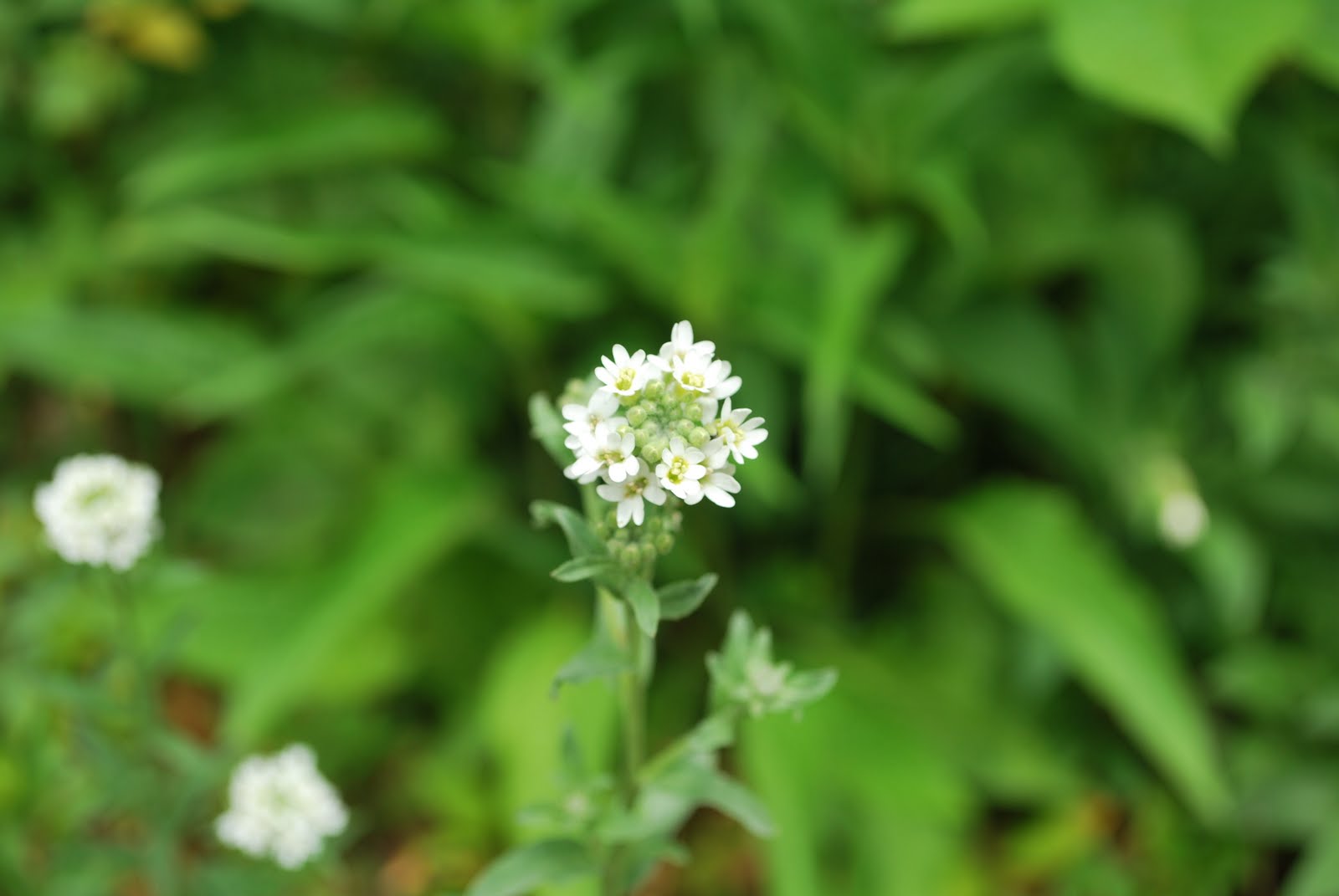
One of the weeds with a small white flower. 
I believe this to be a member of the mustard family. 
I haven't looked it up.

The hydrangeas are in the front yard.  Some flowers are bigger than my hand.  They get so heavy they fall over.  These flowers last for well over a month and are lightly grazed by deer .

For the most part all of my flowers are perennials and return with their beautiful foliage year in and year out.  The two items of maintenance are removing the old stems every year and trying to keep the weeds out.  Last year I removed the old stems by mowing over the whole perennial bed after the killing frost and the foliage had dried up.  This year I just did it by hand.   For weed control I use a Crabgrass Killer with Dimension that will last up to four months.  Last year I used Green Light’s Amaze.  I have been amazed at how effective both products have been.

The Garden Doc

Thursday, July 7, 2011

Raspberries

July 7, 2011    

My wife and daughter just finished picking the first raspberries of the year.  I didn’t see if they came back from picking with red juice stains.  However, they are delicious.  (I snuck a few berries yesterday)  The berries are about three weeks later than last year due to a cool spring.  Five years ago when the raspberries were established five plants of five different varieties were chosen.  I chose based on four criteria; will they grow in a cold climate, berry size, berry flavor, and productivity.  All varieties were from Nourse Berry Farm.

My choice as the best variety is Jaclyn. It is outstanding and it spreads the easiest.  The canes are the tallest of my varieties.  It produces a very large sweet berry, moderate crop size and a spring and fall crop.  There are a few odd berries all through the summer.  It is a primocane beater, meaning it produces berries on the canes the fall the first year the canes emerge.  Most varieties produce primocanes the first year which do not bear, then the following year those canes produce berries.  That fall those canes die and during the year new primocanes grew.    

My second berry choice is a similar but with less yield, smaller berries, and shorter canes.  However, the berries are really good.  The variety may be heritage, but I forget.  Two other choices are just summer bearers and are not my favorites.  Those berries can be small and one spreads faster than it produces average size berries, but they taste good.  They are forgettable and will slowly get replaced with Jaclyn. 

Royalty is my only purple berry.  It was advertised as really sweet.  I didn’t find that to be true.  However it yields for the shortest period of time but is the heaviest bearer. Royalty also spreads less than other varieties which will cause it to be replaced by natural spread of the other varieties. The berries have fair flavor but when looking to make jam or jelly it is a great variety to bring up the berry volume fast to have good jam. 

The first berries were all planted in one single row.  The row is now two rows and I regularly remove primocanes that are growing outside the desired rows.  The berries are kept inside a crude wire structure to help the berries be upright.

Raspberries are a hardy plant but can have insect and disease problems.  My berries have not had significant insect problems or stem disease problems but have had diseases on the berries.  Spray as needed to control problems.  A good neem oil or neem with pyrethrins should work well.  Green Light Neem Oil Concentrate or Green Light Fruit Tree Spray are good choices.  The main problem my berries have had is fruit rot or gray mold, (Botrytis cinerea or soft rot (Ryhizopus and Mucor spp.).  Regular use of Fruit Tree Spray or Neem oil should stop or slow most disease.   Once it fruit rots get established it may be treated with a stronger non organic fungicide Daconil, which is generic or Fung-onil.  Both contain chlorothalonil which must be used weekly and has a pre-harvest interval which should be adhered to.  Neem oil and Fruit Tree Spray can be used the day before harvest. 

Here are some management practices.  They are published in Hort Mag.
1.      Remove dead canes. The presence of empty fruit stems identifies dead or dying canes, as does their yellowing foliage, and roughness of the bark. These canes should be cut low to the ground and removed. (Primocane-fruiting canes that have been left to bear a second year’s crop can be left and will produce a spring crop.) Raspberry canes are less thorny than blackberries, but a leather glove on at least one hand will make handling the canes easy and protect your fingers.
2.      Thin new canes. A vigorously growing raspberry patch will generate an excess of new canes. Some of these will appear at the edges of the patch, causing it to spread. But even within bounds, too many canes left one year will block the growth of canes the next. Good raspberry pruning anticipates not simply next year’s harvest but the harvest of the summer after. Thin the one-season-old canes, leaving the thickest and tallest ones spaced an average of six inches apart.
3.      Weed. With the pruning completed, use a hand hoe or other weeder to clean out grass and other weeds, being careful not to injure the raspberries’ shallow root system. 
4.      Mulch. The first ten feet of row have now been pruned and mulched. Several inches of free-draining wood chips will help the weeds from reappearing. Twin horizontal strings will support the fruit-heavy canes when they bear next summer.
Berries grow different in different environments.  Varieties that do well for me may not do well for you.  They will also grow different in different soil types.

We truly eat all the berries we want all year around.  We bottle them for use during the winter months. Eat lots of a true fruit of the Gods, raspberries.

The Garden Doc

Saturday, July 2, 2011

How to live with or control mosquitoes

July 02

My wife hates to go outside because she attracts mosquitoes, when I don’t even know there are any around.  Several products are available to repel mosquitoes but how effective are they?  Whether or not they are effective is a good question.  A single test can cost millions.  Some of the tests have been made available to the CDC or EPA.  Test results sent to the EPA are to support registrations of products and may not be available for public  use.  The CDC, Center for Disease Control, has research results and does publish some data for the public.  Below is a summary of products and there relative effectiveness.

By far, DEET-containing products are the top performers and most will last from 2 to 6 hours with a single application. Picaridin is the second most effective product with performance in the 1-3 hour range. Oil of Lemon Eucalyptus are considered botanicals and are often labeled as being “green friendly” (whatever that means!). Cedar oil is employed as a scent to repel mosquitoes. The scant data available suggests that these products only last for 15 to 20 minutes after an application. This can be partially solved by finding a formulation that slowly releases the scent into the air.  There are bracelets or tags that hang on clothing that offer a slow release of one or a combination of the above scents. Citronella is listed on the EPA or CDC lists as a mosquito control product. And some of the new mint oils are also not on the list of effective actives.  A pretty good study, done two decades ago, used citronella candles surrounding test subjects.  The test people got bit as frequently as people some distance away, but with no candles nearby.  However, citronella candles seem to be so entrenched in our culture and used for ambiance with everyone thinking they control mosquitoes.  We will likely continue spending millions a year on the little lanterns and keep buying the oil. 

A unique item was found that supposedly gives off a magnetic or electrical field that keeps mosquitoes away from people.  You simply wear it around your neck and they leave you alone.  My suggestion is to make ankle bracelets incorporating the items so they don’t get my wife’s ankles and legs.  Do these items work?  I really can’t say, but I haven’t invested any money in this company.

Mosquito traps have improved and are recognized as being able to reduce mosquito bites when mosquito populations are medium to low.  The expensive ones that work use CO2, a tiny light and a suction fan to attract, pull in and then kill the mosquitoes.  A rather new method of controlling mosquito activity is modifying air movement! Mosquitoes are very weak flyers and don’t like to travel when air movement is in the 8 to 10 mph range or greater. Therefore, using outside ceiling or side fans in an area can greatly reduce mosquito flight and landing ability.  The fans must be turned to blow on the subjects.  

Our family had a wedding reception at our house last summer.  The weather had been very wet and we had a terrific mosquito problem.  My assignment was to make the yard mosquito free.  The methods I employed were four fold.  First, I used my Black Flag fogger which produces a fog that floats on the air.  Any mosquito will have a minute droplet impinge on their body and the small insecticide dose kills them. The fogger was positioned so the fog drifted across the yard and into the brush and trees around the yard.   Next I directly sprayed the vegetation for several feet around the yard and the lawn so mosquitoes that landed would pick up a lethal dose.  This works, because when resting, mosquitoes land on vegetation and get liquids from the surrounding vegetation.  Third, I made sure any mosquito breeding sites were eliminated or treated so my yard did not provide breeding sites.  Fourth, the day of the reception I treated the yard with a cedar oil product from Green Light, YardSafe Insect Repellant.  The aroma kept new mosquitoes from venturing in to attack our guests.  The cedar oil smell was faintly in the air and lasted throughout the afternoon and evening. No one would object to the pleasant smell.  The result was no mosquitoes at the party.

Do yourself a favor when you plan on going outside. Don’t eat bananas.  Eating bananas makes people attractive to mosquitoes.    They are also attracted to CO2 but we do have to breathe.

The Garden Doc

Wednesday, June 1, 2011

Weeds, Weeds, Weeds, Will I Win or Will They?

May 25, 2011

This morning I weeded a couple of rows of my vegetable garden.  The plants from seeds are emerging but just as fast are all the weeds.  Perennial weeds were about 6 inches tall and annuals were an inch or less.  This post is ways to consider fighting the weed war.  Plan ahead and your battle will be much easier to win.  Perennial weeds were about 6 inches tall and annuals were an inch or less.

For perennial beds plan before you plant.  Before you plant anything, prepare the soil then cover the whole area with a quality weed mat or landscape fabric.  These come in long strips and are available at Lowes, Home Depot, Menards and garden centers.  They come in various lengths usually 50 to 100 feet long and 3 or 4 feet wide and then cut to fit.  Commercial sizes are much wider. After the area is covered cut X’s where your plants will go and plant the perennials.  Secure the fabric with stakes and cover with mulch or rocks to make the garden aesthetically acceptable.  In the future you can move the mulch, cut new x’s and plant annuals or perennials.  The more cuts through the weed mats, the more places for weeds to grow.  The weed mats will last for many years.

If your garden is in a new area, spray with a glyphosate herbicide like RoundUp or Com-Pleet to kill all the existing weeds before tilling.  This will kill the hard to manage perennial weeds.

Using mulch to cover the soil is extensively used.  It also looks very professional.  Some weeds come through the mulch but they can be physically removed or sprayed.  Many people add about 3 inches of mulch.  Experts recommend using about 1 inch of mulch.  A thicker mulch layer will inhibit the emergence of more weeds.  If you plan on using thick mulch take this into consideration and plant plants to be at the depth of the top of the mulch.  The worst item you can do for the health of perennials, especially trees and woody ornamentals, is to heap mulch up around the trunk.  Heaping mulch around trees, kills trees.  Still many people like the look and it is still done.

Weeds that come through mulch can be sprayed with RoundUp or Com-Pleet, but don’t allow the spray to contact the ornamental spray.

You may add commercial bagged topsoil to eliminate weeds.  They may still have a small supply of weeds in even though it comes in a bag.  A local topsoil may be ideal for fixing problem soils but be prepared to deal with a new brand of weeds brought in with the topsoil.

Herbicides are used extensively in commercial real estate.  Homeowners don’t have access to all the product used commercially but still can easily control the weeds.  Preen is most commonly used for both ornamental and vegetable gardens.  If this writer were to rate products, the highest rating for weed control with a granule would be Amaze.  If it is not available in your area, ask for it specifically.  Amaze from Green Light has two herbicides, one stronger on grasses and one stronger on broadleaf weeds.  It will last longer than other products for weed control around ornamentals.  Amaze covers more area per pound of granules and will be cheaper than other products.  Amaze should not be used in vegetable gardens.  There is also a Preen for Southern Gardens that uses dithiopyr but cannot be used in vegetable gardens.  It will control weeds for twice as long as regular Preen.  Some of the commercial crabgrass control products can be used in ornamental gardens.  However, read and follow the label directions before making application.  These products often control many more weeds than crabgrass.


Several companies such as Scotts Miracle Gro sell a similar herbicide as Preen.  One such product is Miracle Gro Weed Preventer.  Most Scotts Miracle Gro products use fertilizer as a carrier which may be an overuse of fertilizer.  A commercial product used in ornamental plant beds is BroadStar or SureGuard, a granule and liquid product containing a new herbicide flumioxazin.  If it becomes available for residential use by consumers it will provide long lasting excellent control of weeds. 

Another way to provide good long lasting weed control is to use one of the commercial products with glyphosate and a residual herbicide.  The most common product is RoundUp Extended Control or SeasonLong Grass and Weed Control.  These products kill all the weeds and lay down a layer of herbicide weeds won’t germinate through.  They will provide about 3 to 4 months of weed control.  If these products are sprayed on existing plants or you get too much on the green bark of young trees and shrubs they will also be killed.  Use with EXTREME caution around existing plants.

The historic way is simply hoe out the unwanted plants with a hoe.  If you are growing a vegetable garden, grow a small size garden, small enough so the weed war is small enough to keep under control. 

Happy Gardening!

Thursday, March 24, 2011

Invasive pests on trees and ornamentals

Invasive pests on trees and ornamentals

In the last few years, several very devastating pests have arrived that infest specific plants in various locations throughout the USA.  The list includes the ficus whitefly in Florida; the hemlock woolly adelgid in hemlocks throughout the Appalachian mountains, now spreading to surrounding areas; emerald ash borer in the great lakes states spreading out as far as Tennessee, Missouri, Maryland and by the Hudson river in New York; chili thrips in Texas and other warm climates; marmorated stink bug in the Eastern US across many Midwest states; myoporium thrips in California; and others.  There is also a royal palm bug and a red palm mite that suck juice from the fronds of palm trees.  As travel and international trade continues these invasive pests will continue to invade.  This blog writer will write about some of these pests individually as the season progresses.

These pests arrive with a susceptible host plant or plants that have no resistance to a place where there are no natural predators to keep the population under control.  Ficus, or fig, hemlock, and ash trees are being killed causing heavy financial burdens to homeowners and cities who have to pay to treat or remove these dead trees.  People like trees in their yards and trees lining the streets to keep the neighborhoods fresh, cooled, and beautiful.  Trees cool the environment and shade our homes to lower air conditioning costs.  Losing the trees can reduce the value of the home.  From my youth, I loved climbing trees and climbed as high as possible until I no longer trusted the small branches to hold my few pounds of weight.

What do homeowners do to care for trees that are infested?  Number one choice of many is nothing.  Yes, you can do nothing and with ficus white fly, hemlock woolly adelgid and emerald ash borer, your tree will most likely become infested and after three to five years will die.  Then it will either fall down in a few more years or you will have to cut it down.  Trees falling can injure people and cause damage to nearby cars, homes, and other trees and shrubs.  Cutting trees down on your terms is always better than letting nature put the tree down.  The second choice is to treat the tree to kill the invading insect and save your tree.  Research has shown that you can treat the tree yourself or have it professionally treated with similar positive results.  Get the tree treated before it has declined by 40% or more and your chance of saving the tree is very high. 

Professionals may spray the tree with a high powered spray to kill insects on the outside of the tree that suck juices from the tree -  like ficus white fly and hemlock woolly adelgid.  These types of sprays may also coat the tree trunk and leaves and leave a residual spray that will kill new insects that land on the trunk or leaves for a period of time.  The second type of professional treatment is to drill holes into the tree trunk at the base and inject insecticides into the tree.  When the insect chews or sucks juice from the tree, it gets a lethal dose of insecticide and dies. 

Homeowners rarely have the type of sprayer that allows them to spray higher than about 15 feet.  Many of the insecticides used by professionals can be purchased by homeowners and used with similar results.  These can be applied by drenching or placing granules near the trunk of the tree and watering it into the soil.  These products are very effective when insects drill into the tree and eat the cambium layer.  Research has shown these applications can be just as affective as professional applications.  The cost of these pests on a mature tree may be $1500 for tree removal, $200 for a professional treatment or $20 to $40 for do-it-yourself treating. 

What would a homeowner use?  Several companies provide products.  Imidicloprid is widely used under several product names.  Those names include several brands from Bayer Advanced with the Merit brand, Bonide, Green Light and others usually with Tree & Shrub in the brand name.  Green Light markets a unique product with dinotefuran brand named Safari.  Trade names with the Safari brand include Tree & Shrub with Safari, Emerald Ash Borer Killer and Rose & Flower with Safari Insect Control.  Both imidicloprid and dinotefuran effectively control insects.  Safari gets into the tree or shrub fast because it has higher water solubility and lasts for several months in the tree.  Imidicloprid takes longer getting into the tree, moves slower in the tree but lasts for a few months longer than Safari because it has very low water solubility. 

From a personal point, I have treated an azalea bush with Tree & Shrub with Safari that had skeletonized leaves.  Two days later a bunch of little green worms were all dead and laying on the ground under the bush.  Two red pine trees with woodpeckers attacking them for the insects were treated and both have stayed alive and are recuperating nicely.  One of the red pines had about 75% of the needles lost due to insect injury.  Another tree died before I treated the living tree and the insects had eaten the cambium layer under the bark.  These products are amazing at killing insects that attack trees and shrubs. 

If you live in an area with these insects, do treat your trees.  Doing so will save the tree and maintain the value of your property.

The Garden Doc