Wednesday, November 2, 2011

More Fall Work

November 1, 2011


The local weekend paper was similar to my last blog listing several items that should be done in the garden this fall.  I commented on vegetables, and now need to write about ornamentals. The Gannett Media writer Bill Cary wrote that now is the time to control weeds.  He is very correct.  Fall is the best time to kill broadleaf weeds in lawns, gardens anywhere you want them controlled.  The herbicide will be taken down into the roots where it will kill the roots.  Most perennials store sugars in the roots to stay alive during their dormant period over winter.  When they have the herbicide in the roots they are more easily killed as well as winter being a help for weed control.    
 
Fall cleanup is a time to make life easier in the spring.  The plants don’t care whether the dead tops are removed in the spring or fall.  The garden may look neater clean than leaving old dead vegetation through out the winter.  Bill Cary suggests that many of perennial plants should be left because they have seeds that will feed the birds through the winter.  I haven’t specialized in feeding birds, but Bill is correct that leaving vegetation will attract wildlife.  The neighborhood deer make regular stops though the winter at all the spots where vegetation is showing.   


Fall is the best time to plant perennial plants.  November in the northern states may be a little late but in the southern states is a perfect time.  The roots have time to get well established before the hot summer months.  Perennial bulbs should be planted in the fall.  Those are daffodils, tulips, crocuses, and hyacinths.  A year ago in the fall I thinned out some miniature irises that were very crowded.  The harvested irises roots planted in new locations were no longer quite as miniature when they were not crowded. 
 
Tender bulb perennials should be removed before fall freeze-up to replant in spring.  Those would be cannas, dahlias, gladiolas, and begonias.  For 20 years in Ohio I had gladiolas that were able to survive year to year along a retaining wall that faced south.  The sun on the retaining wall protected the soil from freezing.  Year after year they required no more care than to occasionally thin the bulbs that multiplied profusely.   The small new bulbs generally didn’t have enough strength to produce a good gladiola flower stalk. 

One flower, from a bulb, I have never tried, but should is amaryllis.  It appears this should be planted in the spring in northern climates.  Any information you have would be appreciated. This is from the website:  http://www.amaryllis.com/pac.htm

Amaryllis-One of a Kind

Of all flowering bulbs, amaryllis are the easiest to bring to bloom.  This can be accomplished indoors or out, and over an extended period of time.  The amaryllis originated in South America's tropical regions and has the botanical name Hippeastrum.  The large flowers and ease with which they can be brought to bloom make amaryllis popular and in demand worldwide.  The amaryllis comes in many beautiful varieties including various shades of red, white, pink, salmon and orange.  There are also many striped and multicolored varieties, usually combining shades of pink or red with white.

The Garden Doc

Wednesday, October 26, 2011

Fall Gardening

October 27, 2011

My neighbor for several years grew a garden.  About early September he would harvest everything, and clear the garden spot in preparation for planting the following year.  He lost a lot of good fall vegetables.  Sarah and Brian, my daughter and son-in-law are still getting zucchini squash from the few plants they planted early spring.  This may be a record for zucchini productivity, but it still chugs along, awaiting the final killing frost.  Several plants will continue to grow and produce until a hard frost kills them. 

Every week since mid September my raspberries have produced 1 to 2 cups of nice disease free berries.  Berry harvest measurement is inaccurate due to the handful I eat every day or two when I walk by.  The last handful was yesterday with a few more berries this morning.   This fall has been quite mild with only some light frosts.  There are more berries to ripen but our chances for many more are slim.  Last year we had a hard frost late September that ended all berry production. 
The most productive zucchinis in the world with a Granddaughter

With planning and mid summer planting several crops do very well into the fall.  Simply look at the days to harvest on the seed package, calculate back from the average frost day and plant.  This is usually sometime in late July or August.  Some crops that grow well planted for fall harvests are Swiss chard, mustard greens, peas and lettuce.  Beets do well planted mid to late summer for a new crop through the fall until deep freezes end the season.  My fall harvested beets grew better than spring planted beets.  Short season carrots will grow very well into the fall.  My spring planted carrots continue to grow in the cool fall months.  After a short drought during August, two inches of rain fell in September.  The carrots doubled in size and some split after they rapidly expanded with the excess moisture.  Some carrots reached 4 inches in diameter.  A later planting would have provided normal size carrots in fall.

Cole crops grow well in the fall months and can withstand heavy frosts.  Early planted brussel sprouts keep producing until temperatures get below 20 F.  Cabbage and broccoli planted mid summer can withstand temperatures to 20 F or sometimes down as low as 15 F.  As a new graduate student and citizen of the great city of Columbus, OH, I visited a friends place who had a broccoli plant that had survived the cold weather clear into December.  There was a nice 4 inch head on the plant.

Radishes planted late can be very tasty as well as being a soil structure enhancement.  A few years ago tillage radishes started to be grown after a crop was harvested in agriculture fields.  The radishes are the long icicle types or Japanese types that grow a deep root that will penetrate deep to increase water penetration after the radish is harvested, eaten by cattle, or just dies due to freezing.  If the weather is mild through the winter and they don’t freeze, they can simply be tilled up in the spring.  There is a chemical in radishes that may be very helpful and provide a natural control of nematodes, a microscopic worm that feeds on plant roots.  Crops grown after a planting of tillage radishes usually have a good yield bump. 

The Garden Doc


Monday, October 17, 2011

Apple harvest

October 17,

Go to the farm market or your local orchard and taste all the varieties of fresh apples you can find.  Here are some of my favorites and assessment of varieties.

My sister has raved on about Honey Crisp.  Yes, they are excellent.  They are firm, sweet, tangy, crispy, delicious with a taste that hangs around, and more.  I have two trees, the first got eaten off by deer twice, even when they left other varieties and I planted the second Honey Crisp in a fence.  The deer know what is good.  The other produced apples last year.  The first is now growing inside the fence.  One online cooking guide states they loose their flavor when cooked.  If they lose flavor, it must make the air smell great.  There is finally enough Honey Crisp around that they were running a $1.69/lb sale locally.  Honey Crisp was developed by Univ. of Minnesota and can only be propagated under license.

SweeTango is the newest variety from University of Minnesota crossing Honey Crisp and Zestar.  I tasted my first SweeTango last year.  They are far and away the best apple I have ever eaten.  I purchased a whole bag and savored them one a day until gone.  There were a few available in my local Pic-n-Save this year. Any grower who has SweeTangos for sale is doing well at $2.99 a pound.  Do you cook with them?  Why bother, just eat them fresh.  Check out www.sweetango.com.

The apple I purchase most often is Gala.  Firm, crisp, good flavor and it is an all around good apple.  It was first grown in New Zealand, then later patented in the US.  (How did that happen?)  Now there are several ‘sports’ of Gala apples with slight variations.  This is an apple that is rated number 2 behind the old standard Red Delicious, which I never buy at a grocer.  A good Red Delicious is a very good apple, but when stored and sold in bags they leave something to be desired.  I have never gone wrong buying Gala apples alone or in the 3 lb bags.  I use them in cooking.

Any of the standard apples in a store with a good produce section should be good.  The ones I occasionally choose after Gala are Fuji, Braeburn, Cameo, and Jonathon. Once I found one called Ambrosia.  It was very good, but I only saw it once. If you can find a good Winesap, it is considered the best by many, but it is very late.  One of the tartest apples is Granny Smith.  I try to avoid green skinned apples for fresh eating, but it is great for cooking as demonstrated Sunday by my son Ben in one of my favorite deserts, apple crisp.  I never tire of apple crisp, warm with fresh vanilla ice cream melting over it.

As a youth, we had Transparent apples trees around.  They are very early and quickly ripened from green to yellow and fell off of the tree.  I longed for a good apple as summer came.  Transparent apples may be the earliest apple variety of the season.  That was before apples could be stored well and well before they were shipped around the world.  They make delicious apple sauce.

My Liberty apple had two apples this year.  They were good.  I never sprayed them and they had no disease and no insects.  For just a good easy apple tree to grow and enjoy, try Liberty or.  It is known for very low disease and no apple scab.

Earlier I bragged, and rightfully so, about SweeTango, but there is one apple that may rival it for over all eating quality, Red Astrachan.  My grandfather had a tree in his yard.  They are tart, maybe the tartest of eating apples, sweet, and become overripe in the shortest time of any variety, then fall from the tree.  They make delicious pies and my mother made apple sauce from them.  Seriously, they went from ripe to overripe in a day or two.  What a wonderful apple, brought to the US from Russia in the 1830’s!  If I had space, this variety would be in my yard.  It doesn’t store at all and will never be shipped.

One of the best all around cooking and eating apples is Golden Delicious.  They keep their integrity when sliced and cooked.  They maintain good flavor and store well.  If I were making apple sauce or apple juice, this would be my first choice.  I often mix apple varieties for pies, apple crisps, sauce and for juice.  Having a good portion of the apples as Golden Delicious really rounds out the taste to be full and flavorful.  Good ripe Golden Delicious apples are quite sweet with firm but not hard flesh.  Rome apples are also bragged as great cooking apples.  They look great and cook well but are far from my favorite for eating fresh.

One of my favorite ways to eat and serve apples is fried.  The recipe below is great for a morning side dish with toast and eggs.

Fried Apple Recipe.

5 apples peeled and sliced
About 1/3 stick of butter {Enough to fry the apples}
1/3 cup of sugar
1/4 cup of flour

Fry the apples in melted butter until they become translucent.  Stir in the sugar and flour until it becomes the consistency of gravy.  Serve hot.  Serves about 4 people.

Thursday, September 29, 2011

Fall harvest and gardening

Sept. 29


Should have put all these in the open cars at church.  Lauren is pleased.
I apologize for the few weeks on vacation.

The first frost of fall was light, just touching the sensitive leaves on a few garden plants.  The days are short and the temperatures are lowering.  What grows in the fall?

BEETS.  Six weeks before the expected frost a new batch of red beets was planted.  Beets mature time is listed as 55 days.  They are right on track with root bulbs at 2 to 3 inches.  They have grown beautifully until a deer ate off the tops of about ¼ of the plants.  The bulbs are still untouched.


PARSNIPS.  Last year a huge crop of parsnips was grown.  Some of the roots were about 4 inches in diameter and about 18 inches long.  For parsnip lovers they were a delight.  Parsnips are often much sweeter when allowed to overwinter in the ground and harvested in the spring.  That turned out to be true.  The unharvested plants grew back and went to seed this year.  For those who keep there own seeds, they were very easy to collect.  In far north climates a thick layer of straw or other mulch may help the parsnips survive the extreme cold.  A good layer of snow is also a good protector.

CARROTS.  In some climates carrots will overwinter well in the soil.  Like parsnips they may become sweeter over the winter.  They may be dug throughout the winter if the soil is not frozen.  Next spring the carrots will grow new tops and a seed stock will emerge producing new seeds.  After the seed stock emerges the carrots become woody and not very edible.  Carrots will overwinter better in soil than in a bag.  The next best way to store harvested carrots is cleaned and in a very cool fridge. 

GARLIC.  Fall is the time to plant garlic.  Garlic is a cool season perennial.  Plant now and the garlic bulbs will grow into maturity next summer.  Varieties that do well in cold north climates are the hardneck varieties; Russian Red, Spanish Roja, Chesnock Red, and Giant Siberian are cold hardy and have a milder flavor.  The softneck varieties are less winter tolerant.  Softneck garlic varieties are Italian Late and Silver Rose. Plant the bulb with the root end down.  A garlic bulb has several cloves.  Plant each clove separately and each will produce a new bulb.  Plant about 2 to 3 inches deep about 4 inches apart.  Garlic needs a cold period before it will grow a new bulb.  If left unharvested the next year, the cloves will start to grow next fall.

PUMPKINS AND SQUASH.  The first squash was harvested but unfortunately it was not yet mature.  The first pumpkin was completely orange and is sitting on the front step.  If you want pumpkins and squash to store well, cut the stems just below where they are attached to the vines.  Leave unripe fruit on the vine and it may well mature before freeze-up.  After harvesting store them in a cool dry environment.  They will store for a long time. 

A zinnia, dusted with pollen, from my garden. Photo by Janet.


Wednesday, August 10, 2011

The Fruits of Gardening

Aug. 10, 2011

Just before a week on the road I harvested the first cucumbers, beans, zucchinis and potatoes from my vegetable garden.  Nine days later after returning, the beans were starting to get over ripe, there were tons of zucchini, and there were some cucumbers fit to make little boats but not to eat.  Sweet corn is offered for sale now along the roadsides and my sweet corn is one week from harvest.  One of my main joys in life is biting into a fresh ear of sweet corn.  Onions are growing at a very rapid rate.  One tomato has ripened but it was split and not fit to eat.  Another few days and more will ripen.  In the northern climates all things are not early season.

The old over ripe fruit has been harvested and discarded.  Cucumbers, zucchini and beans will continue to blossom and grow new produce.  Items like cabbage and broccoli are more once and done vegetables even though they try to re-grow.
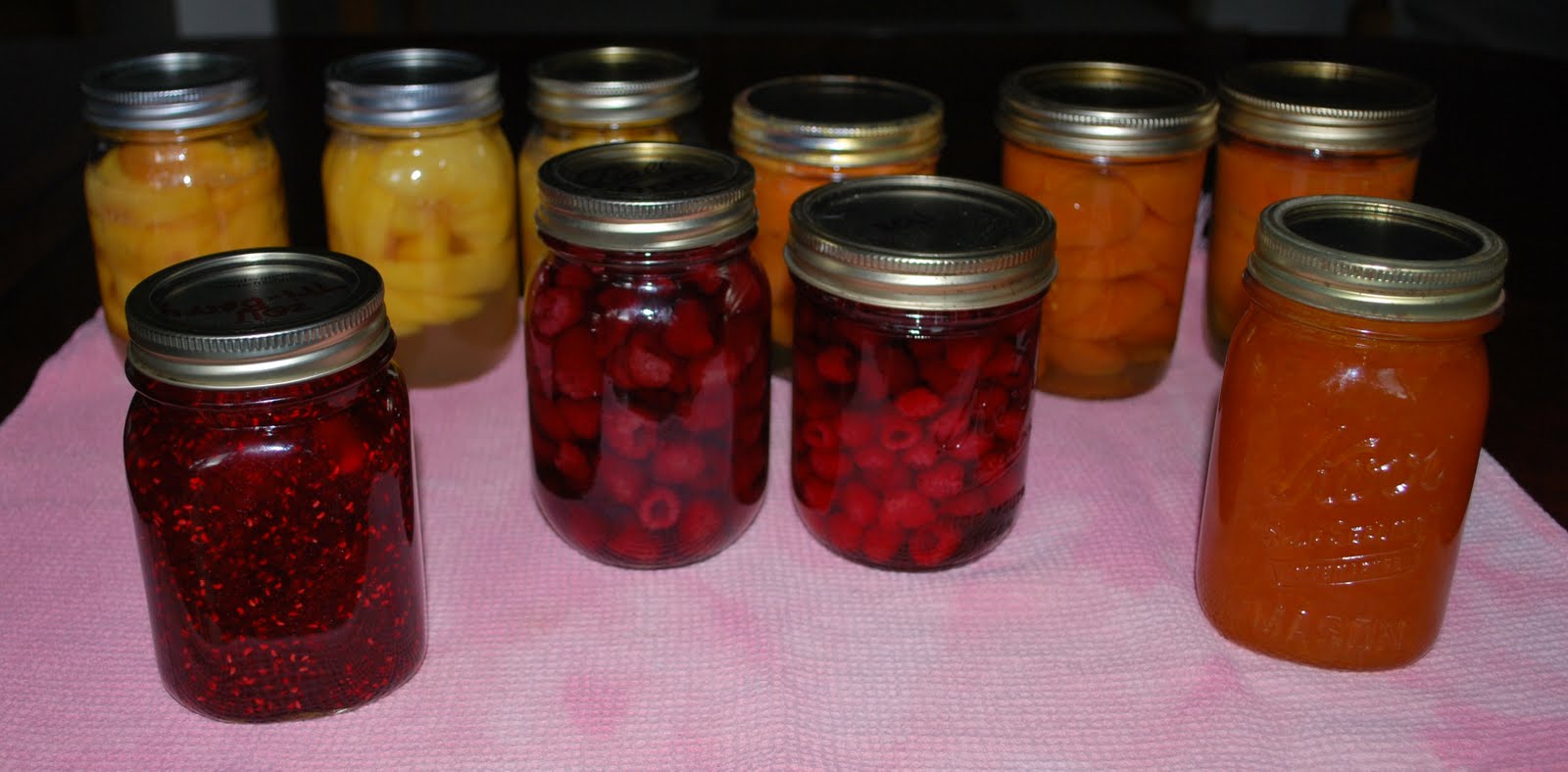
Peaches, apricots, raspberries, raspberry jam, and apricot jam

While traveling from the great Northern plains to the West I had the opportunity to buy some peaches and apricots.  We have harvested loads of raspberries from our plants.  We are filling our fruit jars.  Two weeks ago it looked like we would have loads of blueberries on our 6 bushes.  There are hardly any as a chipmunk has climbed up and eaten more than his share and left us with a handful.

Yesterday for dinner we had zucchini cut in half and filled with a scrambled egg zucchini flesh mixture with cheese melted over it and small red potatoes.  They were delicious.  Tonight we had a crock pot meal of corned beef with cabbage, green beans, carrots, and garden russet potatoes that had been cooking all day.

Harvest is now in full force with more zucchini than I can give away and enough cucumbers to make pickles.  The two types of pickles I will make are little whole dills from cucumbers 2 to 3 inches long and bread and butter pickles from larger cucumbers cut up.  Last night my daughter and I snapped, processed and froze about 8 packages of beans.  Tonight 13 pints of sweet and dill pickles were made. 

After having almost perfect weed control another round of new weeds has emerged and is growing exponentially trying to get seeds produced before the season ends in 6 to 7 weeks.  Rain has been abundant and in good fertile soil some of the plants are over running others even on 4 foot row spacing.

I have two gardens, one to eat from and one for research.

The purpose for such a large research garden is to test two chemicals.  One is for disease control and the other for insect control.  One of the major insects has been Colorado potato beetle.  The insecticide is sold commercially for beetle control and is completely controlling the beetles.  The potatoes not treated are completely defoliated.  The cabbage, broccoli and brussel sprouts are being chewed rapidly by cabbage worms.  The insecticide does not control those worms.  Later thrips on onions will be counted and powdery mildew on various plant species will be measured.  For good thrip numbers we need more hot dry weather.  So far, no disease is evident.  There are also five species of flowers. 

The two purposes of this research is to determine if spraying the chemical will harm the vegetation it is sprayed on and if the fungicide controls disease and the insecticide kills insects.  The two chemicals are sprayed alone and then a combination of the two is sprayed.  The chemicals and combination treatment are sprayed at the use rate and at four times the use rate to simulate over application.  Over application is often done by homeowners even though it is not necessary.  Amongst garden chemical testing, the main mantra is “Do No Harm” as sometimes the cure is worse than the problem.

Tuesday, August 2, 2011

Radio Gardening Shows

July 30, 2011

Driving across the great state of Iowa Saturday morning looking for a good radio show I came across the garden show on AM 600 WMT.  There were two hosts that answered questions as callers called in.  Here are a few of the questions and answers discussed on the show. 

My peas all dried up, if I cut them off will they grow back?  Peas are a cool weather crop and do much better in cool weather.  The hot weather of the past few weeds caused them to die.  Peas are a short season crop and a further question was, can I replant?  Yes, but you will be better off to wait a couple more weeks until the weather is a little cooler.

My beans are not doing well, can I cut them off and will they grow back?  They probably would grow back but they grow really fast and you would be better off to replant.  You still have time to plant and get a good crop before the season ends.

My zucchini plants germinated and were growing nicely.  There were lots of blossoms and I kept waiting for the fruit to grow.  It looked like they were starting but they never grew.  Zucchinis and most other garden produce need to be pollinated.  There just aren’t as many bees around to pollinate as there used to be.  A note from the Garden Doc—the hosts mentioned tomatoes need pollinated.  Tomatoes are self fertile, meaning each flower has both male and female flowers.  However they do need some movement such as wind to get the pollen from the pistils to the stamens. 

My zucchini were growing well then one at a time the vine turned yellow and dried up. What can I do?  The hosts said that zucchini grow fast and there is still time to replant and get plenty of fruit.  The Garden Doc says zucchini, cucumbers and several other of the vine type plants have stem borers that drill into the vine and then the vine dies.    This can also be alleviated by vigilant use of the proper insecticide.  Malathion and Sevin would be good choices.  Spinosad may work. 

My tomatoes have very large worms that are eating the tops of the plants.  The worms are tomato horn worms and are easily controlled by Sevin or Bt.  Bt is short for Bacillus thuringiensis.  (The garden hosts butchered the scientific name.)

There are three big pine trees in my yard, one of them dropped a lot of needles about a month ago.  What could be wrong with it?  The other two are doing well.  The season has been pretty rough on perennials due to the excessive rains that have fallen during the spring.  Trees are tough and the tree will probably be ok.  The hosts did make sure that they were pines.  From the Garden Doc;  A new lawn chemical has been made available this year and was extensively used by some lawn services.  About a month later the new growth on pines and possibly other conifers started dying and in some cases the whole tree appeared to die.  Whether the tree will die or not will not be known until next year but it is a serious problem.  If you have injured pine trees and used a lawn service ask if they used the herbicide Imprelis.

One person called saying he lives by several corn and soybean fields.  He had lots of monarch butterflies in his yard then the plane came spraying the soybeans and corn   Since then there have been very few monarch butterflies but they are starting to come back now.  He wondered what might be getting sprayed with.  The hosts didn’t know.  Many corn and soybean acres are now getting sprayed with fungicides to protect the yield from several diseases that would cause a yield loss.  Soybeans do have several insects such as aphids and the new marmolated stink bug that can cause a large yield loss. 

The last caller had several 3 to 4 year old rhododendrons plants that have curled up leaves.  What could be wrong with the plants?  The hosts weren’t sure what caused it and were not positive that the plants would survive.  The only thought the hosts had were that the plants may have had too much water.  Identifying problems on plants not doing well is one of the most difficult things a plant doctor can determine. 

Let me know your questions.

The Garden Doc

Friday, July 22, 2011

Summer Flowers


A well landscaped yard

Recently I visited my brother.  He had some of his yard professionally landscaped.  The ornamentals in his yard are a succession of blooms all summer long.  There are a few non blooming ornamentals.  During my visit there was a wonderful aroma from the Idaho state flower, the syringa.  The bushes were 5 to 6 feet tall and in full bloom.  I would recommend syringa for anybody who lives in a location that can grow them. 
Poppies in the corner garden
                                           
 One of my great nostalgic memories is going to my Grandparents house and seeing the big beautiful poppies like the ones in the picture.  They are short lived but very colorful.  I have a nice bed with both orange and mostly red flowers.  The flowers are four inches wide.  Bees love the poppies.


Dames rocket.  These grow wild along Ohio backroads
Along the back of the lawn are some perennials that have a selection of blooms throughout the spring and summer.  The first to flower to bloom are dames rocket (Hesperis), then Monarda and purple coneflowers (Echinacea), then the last is goldenrod.  There are some others that I don’t know if they are weeds or just someone else’s idea of a flower.  Either way, I just pulled a bunch of aster like weeds out. 

The corners of my back yard have different flowers with the most common being day lilies. There are daisies, poppies, some different irises a few hostas, and some catnip.

I have never looked this flower up to see what it is.

The one item I would change is to have more flowers in the front yard.  I have added some through the years.  The big addition is some azaleas in one bed and some daffodils and tulips.  I like roses but they struggle in the sandy soil, probably due to lack of moisture.  The big addition I have made is two beautiful lilacs to the side of the front yard.  They were a gift from a friend who had too much shade so they never bloomed.   


These are sure beautiful.  Notice the water droplets on the leaves.
I wish I knew the variety.
 Again, I haven't taken the time to look up the variety.

 
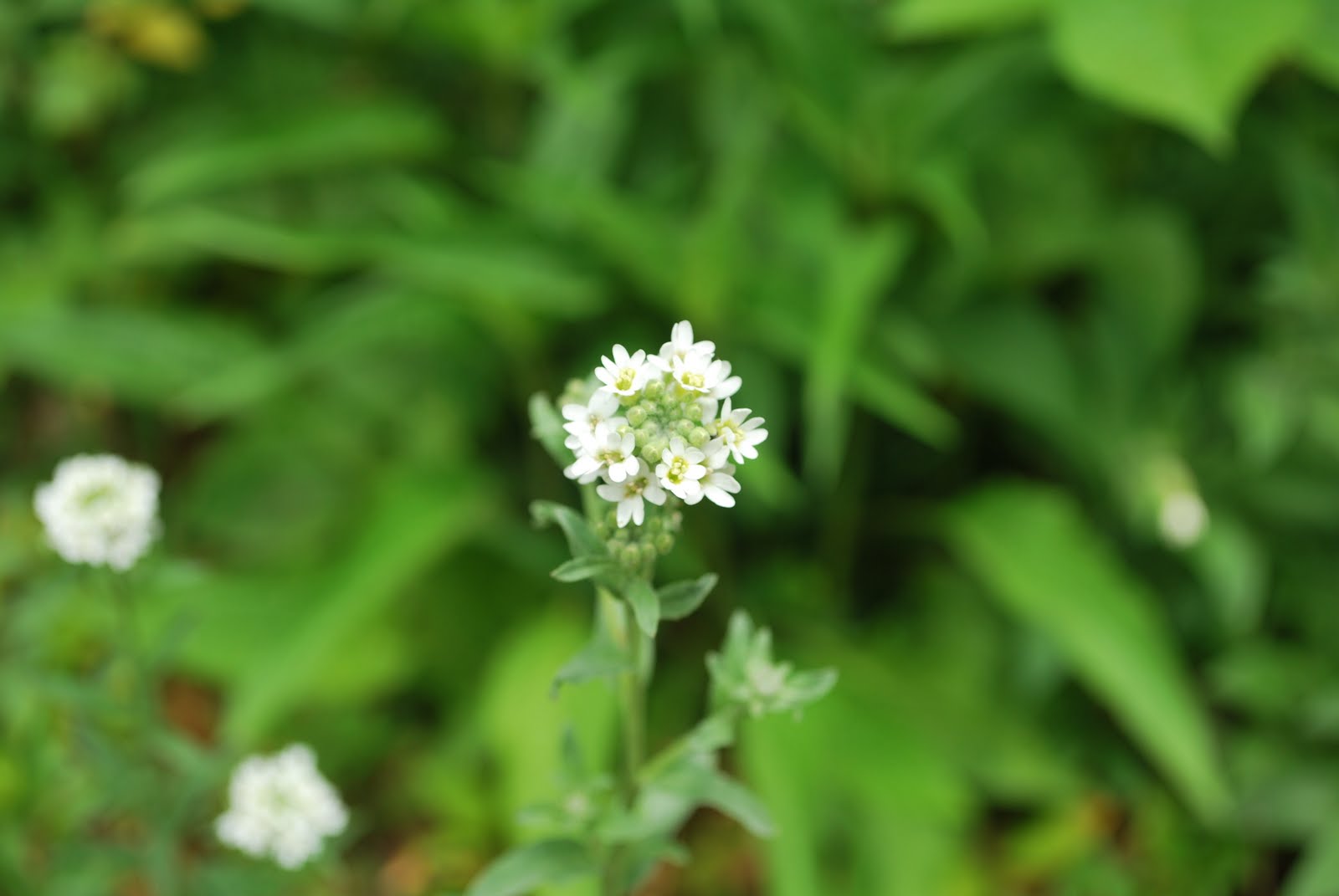
One of the weeds with a small white flower. 
I believe this to be a member of the mustard family. 
I haven't looked it up.

The hydrangeas are in the front yard.  Some flowers are bigger than my hand.  They get so heavy they fall over.  These flowers last for well over a month and are lightly grazed by deer .

For the most part all of my flowers are perennials and return with their beautiful foliage year in and year out.  The two items of maintenance are removing the old stems every year and trying to keep the weeds out.  Last year I removed the old stems by mowing over the whole perennial bed after the killing frost and the foliage had dried up.  This year I just did it by hand.   For weed control I use a Crabgrass Killer with Dimension that will last up to four months.  Last year I used Green Light’s Amaze.  I have been amazed at how effective both products have been.

The Garden Doc